On this page
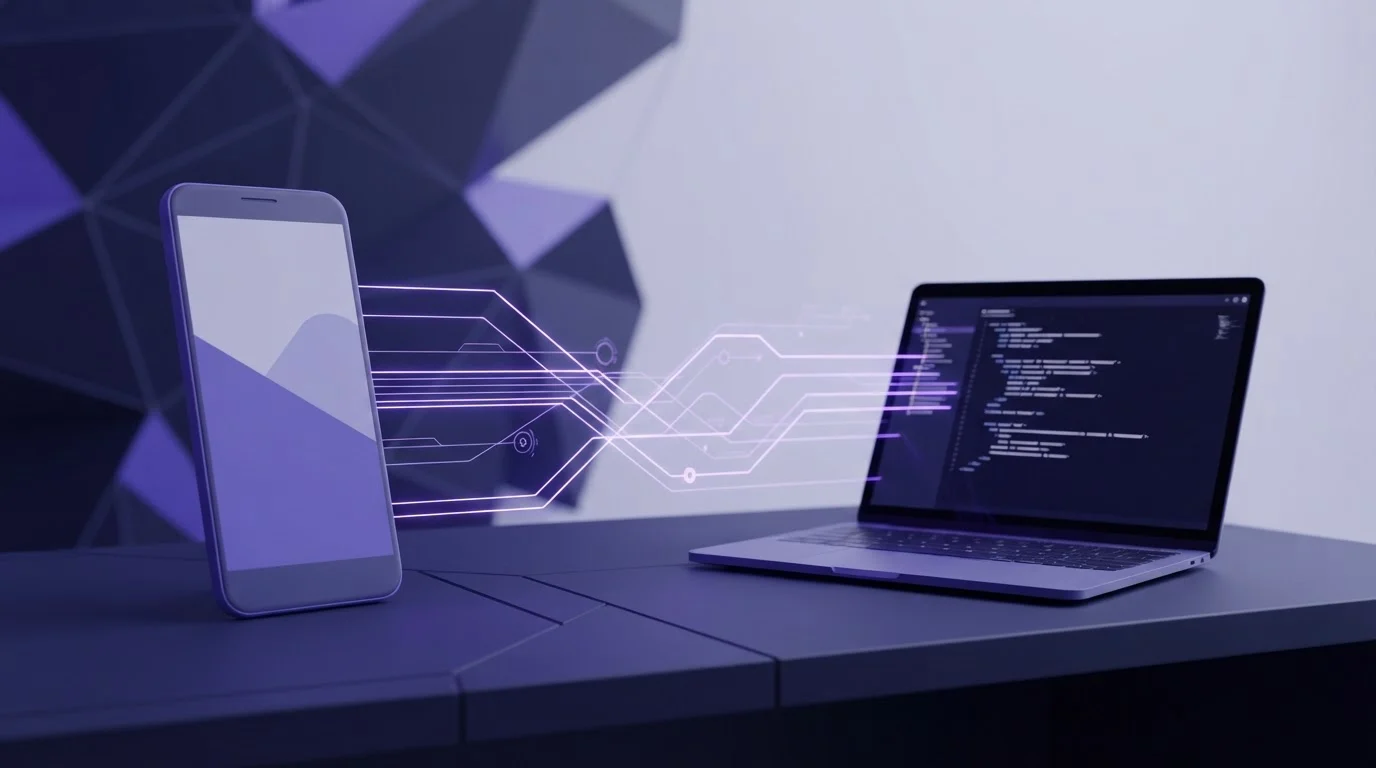
Yes, you can pair Android wireless debugging to an MCP server completely without a USB cable using native Android wireless pairing or ScreenSync MCP over your local Wi-Fi network. At ScreenSync MCP, our free system connects your phone to a desktop hub exposing 226 Model Context Protocol (MCP) tools directly to clients like Claude Desktop and Claude Code without requiring physical tethering.
Setting up untethered connections lets developers inspect layouts, capture live screens, and issue input events from an AI agent without keeping devices plugged into their workstations. Here is the technical breakdown of how to set up Android wireless debugging for an MCP server without a USB cable, what architecture makes it possible, and how to troubleshoot connection drops.
Key Takeaways
- Screen capture operates via Android's MediaProjection API and needs no root and no ADB.
- Device control tools (
control_tap,control_swipe,control_type) require an ADB bridge over USB or wireless debugging. - Android 11 and later support zero-cable pairing using native
adb pairwith a pairing code and dynamic port. - ScreenSync MCP provides 226 tools across 29 phone/desktop tools and 197 browser tools to stdio MCP clients.
- All network frames remain local on your LAN; only agent-requested screenshots are sent to your chosen AI model provider.
What It Is and Why It Matters
Wireless debugging allows your workstation to communicate with your Android device over a local Wi-Fi connection without an initial physical USB handshake. This eliminates workstation cable clutter and enables persistent remote automation workflows for AI agents running on host machines.
What It Is and Why It Matters
The Cableless Automation Workflow
Traditionally, developers had to connect an Android device via USB to run adb tcpip 5555 before unplugging it for network control. Modern Android wireless debugging eliminates that first step by introducing a dedicated pairing dialog directly within Developer Options. Once paired, an agent interacting via the Model Context Protocol (MCP) can issue inputs, inspect interfaces, and read logs entirely over Wi-Fi.
Why AI Agents Need Mobile Context
AI agents running in environments like Claude Desktop or Claude Code rely on real-time feedback to execute automated tasks. When an agent can see the mobile screen and issue input actions, it can execute automated QA flows, reproduce UI bugs, and verify multi-factor authentication steps directly on real hardware.
ScreenSync MCP Architecture
ScreenSync MCP splits the capture and control layers to optimize performance and security. Screen capture streams directly from our Android app (Android 7.0 or later, free on Google Play as com.screensync.mcp) to the desktop hub via MediaProjection without root access. Meanwhile, 12 control actions execute via standard ADB wireless commands orchestrated through our local Node.js hub running on port 3000.
| Control Option | Who It Suits | What Makes It Different |
|---|---|---|
| ScreenSync MCP | Developers and QA engineers | Combines MediaProjection with ADB control and real browser tools |
| Native ADB over Wi-Fi | CLI-focused developers | Requires manual terminal pairing and dynamic port reconfiguration |
| USB Tethering | Fixed workstation setups | Requires physical cables but avoids Wi-Fi network drops |
How It Works
Wireless pairing decouples the video streaming pipeline from the input execution pipeline across your local network. Understanding this separation clarifies why screen reading works out of the box while interaction requires debugging permissions.
Dual-Pipeline Operation
Our system splits responsibilities into two distinct channels. The ScreenSync MCP Android app streams frames directly to the Node.js hub via your local network using MediaProjection after you grant permission at session start. For input commands such as control_tap or control_swipe, the hub sends commands through the active ADB daemon connected over your local network.
+-----------------------+ +------------------------+
| Android Device | | Desktop Machine |
| | | |
| MediaProjection App |== Frames ===>| Node.js Hub (Port 3000)|
| | (No ADB) | |
| ADB Wireless Daemon |<== Control ==| ADB Client Engine |
| | (Needs ADB) | ^ |
+-----------------------+ +-----------|------------+
| Stdio
+-----------v------------+
| MCP Client (Claude) |
+------------------------+
Stdio Transport Protocol
Claude Desktop, Claude Code, and Cursor connect to local MCP servers via standard input/output (stdio). When you configure ScreenSync MCP, your MCP client spawns the hub script directly (screensync-hub.js). The hub translates client tool calls into local ADB commands or HTTP queries and returns UI structures or image payloads back across stdio.
Dynamic Ports vs Fixed Hub Endpoints
Android assigns dynamic ports for wireless pairing and connection security. While native ADB ports can change when Wi-Fi cycles, the ScreenSync MCP hub always listens locally on HTTP port 3000 for app handshakes. You pair your mobile app to the desktop hub by scanning a QR code or through LAN mDNS auto-discovery authenticated by your SCREEN_SYNC_TOKEN.
Step-by-Step Walkthrough
Connecting without any USB cable requires pairing the device's ADB daemon over Wi-Fi, starting your desktop hub, and configuring your MCP client.
1. Enable Wireless Debugging on Android
Navigate to Settings > Developer Options on your Android device (Android 11 or higher is required for cable-free pairing). Toggle Wireless debugging to ON while connected to the same Wi-Fi network as your computer. Tap into the Wireless debugging settings menu to view your device pairing options.
2. Pair Device and Host Terminal
Tap Pair device with pairing code. A dialog will appear displaying a Wi-Fi pairing code, an IP address, and a dynamic 5-digit port. On your desktop terminal, run:
bash
adb pair 192.168.1.50:PORT_FROM_DIALOG
Enter the 6-digit code when prompted. Once paired, view the main Wireless debugging screen for the active connection IP and dynamic port, then connect:
bash
adb connect 192.168.1.50:PORT_ON_MAIN_SCREEN
Verify that the device appears as connected by running adb devices.
3. Launch the ScreenSync MCP Hub
Download the ScreenSync MCP hub (free download) and ensure you have Node.js 18+ installed on Windows, macOS, or Linux. Start the hub using the provided startup script:
bash
On Windows:
start-hub.bat
On macOS / Linux:
./start-hub.sh
The hub initiates an HTTP server on port 3000. Open the ScreenSync MCP app (com.screensync.mcp) on your phone and either scan the hub's QR code or let mDNS auto-discovery connect across your LAN. You can learn more about network diagnostics in our guide on how MCP server not connecting to Android: fix pairing and mDNS.
4. Configure Your MCP Client
Configure your MCP client to launch the hub via stdio using the generated SCREEN_SYNC_TOKEN. For Claude Code, add the server directly through the CLI:
bash
claude mcp add screensync node "/path/to/hub/screensync-hub.js"
For Claude Desktop, open your claude_desktop_config.json (via Settings > Developer) and define the server block:
{
"mcpServers": {
"screensync": {
"command": "node",
"args": ["/path/to/hub/screensync-hub.js"],
"env": {
"SCREEN_SYNC_TOKEN": "your_token_here"
}
}
}
}
Once configured, restart your client to expose all 226 tools.
Example Prompts and Tool Calls
When your AI agent interacts with your Android device, it evaluates the visual state, reads interface hierarchies, and issues hardware inputs using distinct tool calls.
Inspecting UI Hierarchy
Instead of parsing raw pixels for every minor interaction, an agent can read layout trees directly to find view IDs and text labels without guessing coordinates. See our deep-dive on how AI agents use Android UI trees not screenshots to understand how this reduces token consumption.
User Prompt:
Check the current screen, identify the search input field, and tap it.
Agent Execution:
- The agent calls
get_ui_hierarchyto parse interactive view bounds. - The hub runs the ADB dump and returns the node tree.
- The agent targets the node's bounds and calls
control_tapwith the targetxandycoordinates.
Executing Screen Capture and Typing
For complex visual verification, agents pull real-time images using our MediaProjection capture pipeline.
User Prompt:
Capture the current screen, verify if the checkout button is active, and type 'SAVE20' into the promo field.
Agent Execution:
- Agent calls
get_latest_screenshotto retrieve the current frame from the hub. - Agent locates the text field coordinates.
- Agent calls
control_tapto focus the input. - Agent calls
control_typewithtext="SAVE20".
Monitoring Device Logs
QA workflows often require confirming whether an app error occurred behind the scenes during user flows.
User Prompt:
Tap the submit button and check logcat for any runtime exceptions.
Agent Execution:
- Agent calls
control_tapon the target button. - Agent executes
get_logcatwith filtering parameters to inspect standard error output directly from the device.
Common Mistakes and Troubleshooting
Setting up wireless debugging without a cable introduces specific network edge cases. Here is how to diagnose common failure modes.
Dynamic Port Resets
Unlike traditional USB debugging or wired TCP setups, Android regenerates its wireless debugging port whenever Wi-Fi disconnects or toggles. If tool calls fail with connection refused errors, check Developer Options on your device to confirm the new port and execute adb connect IP:NEW_PORT.
Subnet and Client Isolation
If mDNS discovery fails or adb connect hangs indefinitely, ensure your phone and computer share the same network subnet. Many corporate and guest Wi-Fi networks enable Access Point (AP) isolation, preventing wireless clients from communicating directly with each other.
Missing MediaProjection Consent
ScreenSync MCP captures screens without root or ADB using standard Android APIs. However, Android requires explicit user consent for MediaProjection each session. If get_latest_screenshot returns blank or outdated frames, check your phone screen and accept the system capture prompt.
| Tool or Component | License / Pricing | System Requirements |
|---|---|---|
| ScreenSync MCP Android App | Free on Google Play | Android 7.0 or later |
| ScreenSync MCP Desktop Hub | Free download | Node.js 18+ (Win, Mac, Linux) |
| ScreenSync MCP Browser Extension | Free download | Chrome or Edge (MV3) |
Privacy and Safety Notes
Understanding where your telemetry and screen data travel is vital when operating autonomous developer tools.
Local Network Isolation
All real-time video frames streamed between the ScreenSync MCP Android app and the desktop hub remain strictly inside your local area network. No video frames or device input commands are routed through EpsolDev servers. A Google Drive fallback mode is available optionally if direct local transfer is restricted by your local environment.
Model Provider Data Transfers
While our hub keeps data local, keep in mind that whenever an AI agent requests a visual check via get_latest_screenshot, that frame is sent directly to your configured AI agent's model provider (such as Anthropic for Claude Desktop). Avoid opening views containing sensitive credentials or personal financial data during autonomous runs.
Browser Safety Approvals
Alongside 29 phone and desktop tools (12 control_*, 3 os_*, 14 capture/hub tools such as get_latest_screenshot, get_ui_hierarchy, and get_logcat), the hub provides 197 web_* tools using our Chrome/Edge extension (MV3). For sensitive browser actions, the extension enforces human approval prompts directly inside your active browser session before high-impact changes execute.
Setup Verification Checklist
Before executing autonomous tasks with your AI agent, confirm the following:
- Phone and host machine are on the same Wi-Fi subnet with AP isolation disabled.
- Wireless debugging is toggled ON in Developer Options.
- ADB connection verified via
adb devicesshowing your IP and dynamic port. - Node.js 18+ installed and
start-hub.batorstart-hub.shrunning. - MediaProjection permission approved on your Android device display.
- MCP client config pointed to
screensync-hub.jswith your validSCREEN_SYNC_TOKEN.
Conclusion
Pairing Android wireless debugging to an MCP server without a USB cable is completely viable on modern Android devices and offers developers a cable-free mobile automation pipeline. For developers, QA engineers, and power users of Claude Desktop, Claude Code, and Cursor, setting up ScreenSync MCP bridges your real phone and desktop browser directly to AI agents.
ScreenSync MCP delivers autonomous control and visual context for real devices worldwide. For inquiries, reach out to [email protected] or visit https://www.screensyncmcp.tech to download our tools. Get it on Google Play to install the ScreenSync MCP Android app, ScreenSync MCP hub, and ScreenSync MCP browser extension.
Questions, answered
Can I pair wireless debugging without ever plugging in a USB cable?
Yes. Android 11 and later provide a native pairing code option under Developer Options that allows you to complete initial pairing directly over Wi-Fi using the adb pair command.
Does ScreenSync MCP require root access on my Android phone?
No, ScreenSync MCP does not require root access. Screen capture utilizes Android's native MediaProjection API, and device control runs through standard ADB commands.
Which desktop clients work with ScreenSync MCP?
ScreenSync MCP works with MCP clients that run local stdio servers, such as Claude Desktop, Claude Code, Cursor, and VS Code. ChatGPT's web app requires remote HTTPS MCP and is not supported.
Do video frames leave my local network when streaming?
No, live screen frames pass directly between the Android app and the desktop hub over your local network and are never sent to EpsolDev servers. However, screenshots explicitly requested by an AI agent are transmitted to that agent's model provider.
How fast is the screen mirroring latency?
In our internal tests over a local area network, ScreenSync MCP provides a live mirror with approximately 94 ms median latency.